Mount Doom
Mount Doom, known in the Elvish tongue as Orodruin and ominously called the Fiery Mountain or Amon Amarth, is the volcanic peak that rises in the barren plain of Gorgoroth in northwestern Mordor. It is the place where Sauron forged the One Ring in the fires of the Sammath Naur, the Chambers of Fire, during the Second Age, and it is the only place in Middle-earth where that Ring can be unmade. As the physical and symbolic heart of the Dark Lord's power, the mountain is a site of origin, corruption, and final destruction, its very existence a permanent threat to the free peoples of the West.
Origin and Forging of the Ring
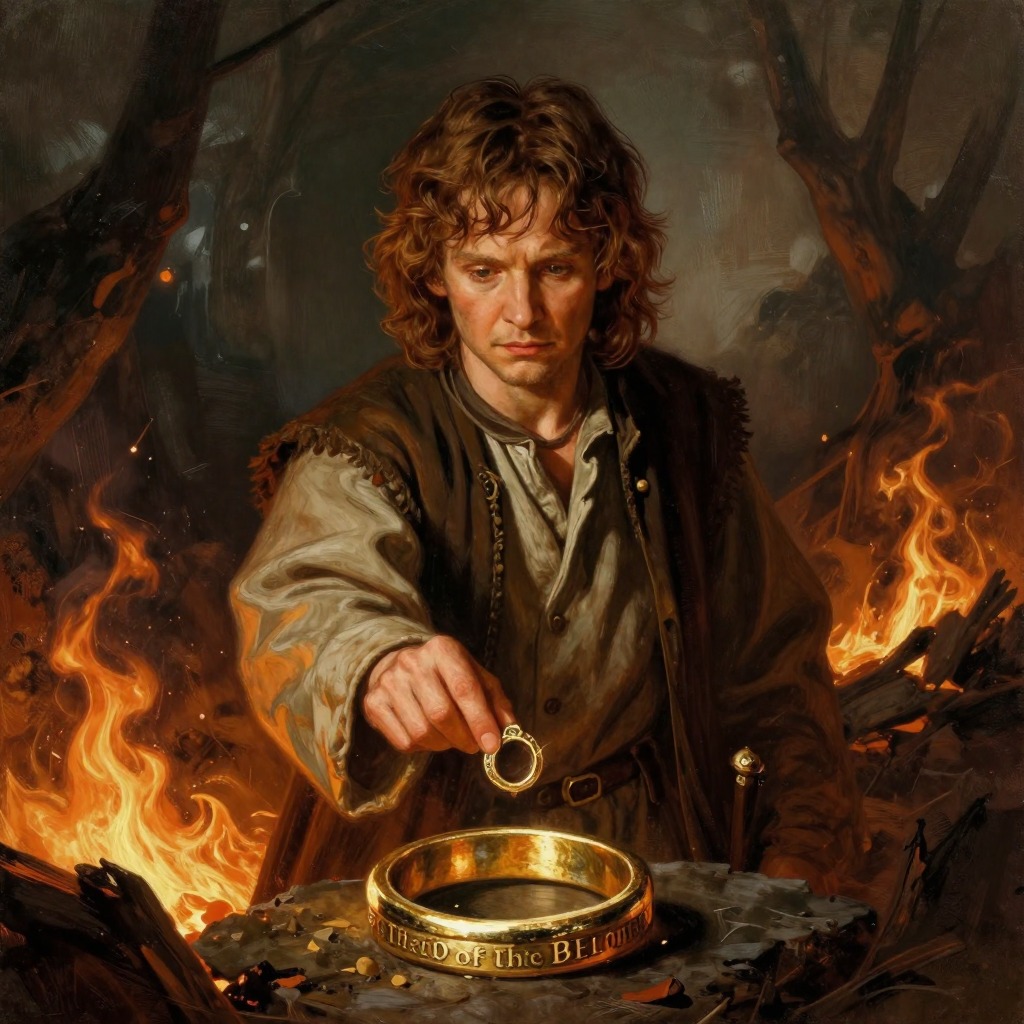
The Ring-verse, known throughout Elven-lore, declares that the One Ring was made "In the Land of Mordor where the Shadows lie," and its forging took place within the Cracks of Doom, the volcanic fissures deep inside Mount Doom. Sauron poured a great part of his own power into the Ring during its creation, making the mountain not merely a forge but an extension of his will. The Ring's inscription, written in the Black Speech of Mordor, was first revealed when the Ring was cast into the fire, proving its identity beyond doubt. The mountain's fires are thus the source of the Ring's power and the only force that can destroy it.
The Quest of the Ring-bearer
The entire quest of Frodo Baggins, the Ring-bearer, is defined by the necessity of reaching Mount Doom. Gandalf the Grey explains that no smith's forge in the Shire, nor even the anvils and furnaces of the Dwarves, can damage the Ring; only dragon-fire might melt lesser Rings of Power, but not the One. The only way to destroy it is to cast it into the Cracks of Doom. This knowledge sets the course of the War of the Ring, driving Frodo and Samwise Gamgee across the desolate plains of Gorgoroth, through the ash-choked land, toward the ever-present, smoking cone of the mountain. The journey is a torment of thirst, weariness, and the growing weight of the Ring, which becomes heavier and more malevolent as it nears its place of origin.
The Final Confrontation and Destruction
At the climax of the quest, Frodo stands within the Sammath Naur, the very chamber where the Ring was forged, and claims the Ring for his own, refusing to destroy it. At that moment, Gollum attacks, biting off Frodo's finger and seizing the Ring. In his mad triumph, Gollum loses his footing and falls into the Cracks of Doom, taking the Ring with him. The destruction of the Ring triggers the catastrophic eruption of Mount Doom. The mountain reels, fire belches from its riven summit, and the entire structure collapses in a torrent of black rain and searing lightning. The Nazgûl, caught in the fiery ruin, are consumed. The fall of Barad-dûr and the end of Sauron's power follow immediately, proving that the mountain's destruction was the final, necessary act to end the War of the Ring.
Symbolic and Narrative Significance
Mount Doom functions as the ultimate symbol of Sauron's power and the peril of the Ring. It is a place of absolute evil, where the air is poisonous, the ground is scorched, and the very light of the sun is blotted out by smoke and ash. The mountain is also a place of judgment: Frodo's failure at the last moment is redeemed by Gollum's unintended act, fulfilling Gandalf's earlier prophecy that Gollum still had a part to play. The mountain's destruction is not merely a physical event but a cosmic one, marking the end of the Third Age and the beginning of the Dominion of Men. The image of Mount Doom, a constant, threatening presence on the horizon, embodies the inescapable nature of the quest and the high cost of victory.